
3,000, 5,000 or 7,500 miles: which oil change interval is right
The 3,000-mile rule is a holdover from older engines and conventional oil; AAA's guidance is that many modern engines on synthetic run 5,000 to 7,500 miles or more between changes, and the owner's manual sets the exact figure. In Northern Nevada, the manual's severe-service interval is usually the one that applies.
4.7 stars from 952 Google reviews
- No appointment needed
- Service while you wait
- Since 1983
- 4 Northern Nevada service centers
- 4.7 stars, 952 Google reviews

Verdict
For most engines built in the last fifteen years running the synthetic oil their manual specifies, 5,000 to 7,500 miles is the right range, with the shorter end for severe service. The 3,000-mile interval still fits older engines on conventional oil, engines that burn or dilute oil, and anyone whose manual says so.
| Interval | Who it fits | What the sources say |
|---|---|---|
| 3,000 miles | Older engines on conventional oil; engines that use oil; extreme short-trip use | AAA: conventional oil and older engines sit closer to 3,000 to 5,000 miles |
| 5,000 miles | Most engines on synthetic under severe service: short trips, dust, towing, heat and cold | The severe-service column in many manuals; AAA's lower bound for synthetic |
| 7,500 miles | Modern engines on synthetic under normal service: longer trips, highway, moderate loads | AAA's upper figure; Kelley Blue Book notes newer engines are engineered for 7,500 to 15,000 |
| 10,000 miles and beyond | Specific engines whose makers publish it, usually with a monitor that counts conditions | Only where the manual states it; the monitor may still call for an earlier change |
| Six months | Any interval, as a calendar backstop for low-mileage vehicles | Most manuals pair the mileage with a time limit, whichever comes first |
When 3,000 miles is the right call
- The manual lists 3,000 miles, or the engine is pre-2000 and runs conventional oil
- The engine uses oil between changes or has had sludge or a timing-chain issue
- Nearly every trip is under a few miles, so the oil never fully warms and sheds moisture
- Direct-injection engines known for fuel dilution of the oil, where the maker or dealer recommends shorter changes
When 5,000 to 7,500 miles is the right call
- The manual specifies synthetic and gives a 5,000-, 7,500- or 10,000-mile figure
- Trips are long enough to warm the engine fully; highway miles on I-80 or I-580 count
- The vehicle has an oil-life monitor and you follow it rather than the sticker
- You use the severe-service figure (often 5,000) for towing, dust, heat and cold, and the normal figure otherwise
The sticker on your windshield used to say 3,000 miles no matter what you drove. Today the right answer depends on the engine, the oil and the driving, and a 2015 pickup towing to Tahoe and a 2022 hybrid commuting to downtown Reno do not share a number. This page compares the three common intervals and shows how to find yours.
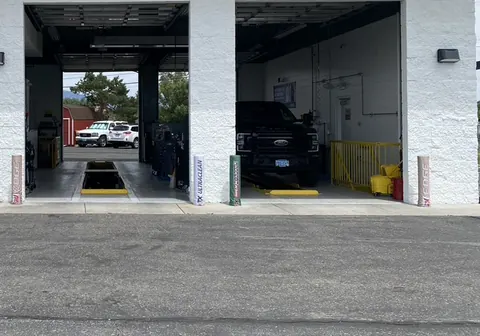
Where the 3,000-mile rule came from
Engines of the 1970s and 1980s ran on conventional oil with weaker additive packages, carburetors that washed fuel past the rings, and looser tolerances. Three thousand miles was a sensible interval for them, and it became a habit that outlived its reason. Kelley Blue Book's guide notes that some drivers still follow the every-3,000-miles rule while newer engines are engineered to go anywhere from 7,500 to 15,000 miles between changes. AAA's position is the same: many modern engines on synthetic run 5,000 to 7,500 miles or more, and the manual decides.
The rule is not wrong for every car. An older engine on conventional oil, an engine that burns oil, or one that only ever moves a few blocks is still well served by a short interval. The mistake is applying it to a modern synthetic-oil engine out of habit, or ignoring it on an old engine out of optimism.
What severe service means here
Open your manual to the maintenance schedule and you will find two columns, normal and severe, and a list of conditions that put you in the severe column: repeated short trips, extensive idling, dusty or gravel roads, towing or carrying heavy loads, sustained high temperatures, very cold weather, and mountain driving. Northern Nevada checks most of those boxes. Reno averages 65 days a year at 90 F or hotter and 122 freezing nights (NOAA 1991-2020 normals); the airport sees only 7.35 inches of rain a year, which means dust; and the drive to Lake Tahoe climbs from our Longley Lane service center at 4,426 feet (USGS) to 8,911 feet at Mount Rose Summit.
For most of our customers, then, the severe-service interval is the honest one. On a typical modern engine that is 5,000 miles rather than 7,500, or whatever the shorter figure in your schedule is. Use the how-often guide and the what's-due tool to compare your mileage against the published figure.
Miles or months, whichever comes first
Oil ages even in a parked car: it absorbs moisture, its additives deplete, and the acids from combustion stay in it. That is why nearly every manual pairs the mileage with a time limit, usually six months or a year. A second vehicle that covers 3,000 miles a year still needs its oil changed on the calendar. The miles vs months guide goes into the chemistry; the short version is that the sticker's date matters as much as its mileage.
Oil-life monitors on many vehicles handle this automatically, counting engine revolutions, temperatures, loads and time rather than plain miles. If your car has one, follow it, and tell the technician so the reset is done correctly when you pull in.
What we put on the sticker
At the four service centers the technician reads the oil cap and the manual, asks how you drive, and writes the next-due mileage on the sticker from the manual's schedule, not from a chart on the wall. If the manual says 7,500 under normal service and you tow a trailer to Topaz every month, you will hear why the shorter figure applies and the sticker will say so. The oil change page explains the rest of the service, and the sticker math post shows how we arrive at the number.
Sources
- aaa.com/autorepair/articles/how-often-should-you-change-your-oil (AAA, 5,000 to 7,500 miles or more on synthetic for many modern engines, read 2026-10-15)
- kbb.com/oil-change (Kelley Blue Book, newer engines engineered for 7,500 to 15,000 miles between changes, read 2026-10-15)
- ncei.noaa.gov/products/land-based-station/us-climate-normals (NOAA NCEI 1991-2020 normals, Reno-Tahoe International Airport, read 2026-10-15)
- apps.nationalmap.gov/epqs/ (USGS elevation at 4993 Longley Ln, 4,426 ft, read 2026-10-15)
- en.wikipedia.org/wiki/Mount_Rose_Summit (Mount Rose Summit, 8,911 ft, read 2026-10-15)
Your service center: Reno Northwest
- Call(775) 787-1000Mon-Fri 8 am-5 pm, Sat 8 am-4 pm, Sun closed
- Address6100 Mae Anne Ave, Reno, NV 89523
Related
Drive in. No appointment. Drive out.
Locally owned in Northern Nevada since 1983. No appointment, no pressure: we tell you what the inspection found and you decide.
About usWashoe County has 304 auto repair and maintenance businesses, 19 of them oil change and lube shops (BLS QCEW, 2025 annual average). See the data
Straight answers
Questions people ask
Still have a question? Call your service center or drive in; there is no appointment to make.
My manual says 10,000 miles. Is that safe here?
If the manual says it, yes, under the conditions it describes. Check whether it also lists a severe-service figure and a time limit; most do, and Northern Nevada driving often meets the severe definition.
Does synthetic oil let me ignore the manual?
No. The interval is set for the engine, and the manual already assumes the oil type it specifies. Synthetic earns its longer interval only where the manual grants one.
What if I lost the manual?
The manufacturer's website publishes the maintenance schedule for most model years, and our vehicle pages list the typical grade and interval by make with the maker's page cited.

Four service centers, no appointment
Drive in today. No appointment needed.
No appointment needed at any of the four service centers. Questions first? Send the form and the service center you pick answers during business hours.
4.7 stars from 952 Google reviews
- No appointment needed
- Service while you wait
- Since 1983
- 4 Northern Nevada service centers
- 4.7 stars, 952 Google reviews