
Northern Nevada buys a lot of AWD and 4WD. Subarus, Tacomas, 4Runners, F-150s, Wranglers, Outbacks and Tahoes line the streets from Caughlin Ranch to the Ranchos, and for good reason: about 21 inches of snow falls at the Reno airport in a typical year and more in the foothills (NOAA 1991-2020 normals). The extra traction comes with extra gearboxes, and those gearboxes have fluid that rarely gets the attention engine oil does.

At a glance
- AWD and 4WD vehicles have two differentials and usually a transfer case or PTU.
- Each holds its own fluid, often a gear oil such as 75W-90 or a maker-specific fluid.
- Towing, gravel, sand and water crossings count as severe service.
- The intervals are in your manual; they are often shorter than people expect.
What do the differentials and transfer case do?
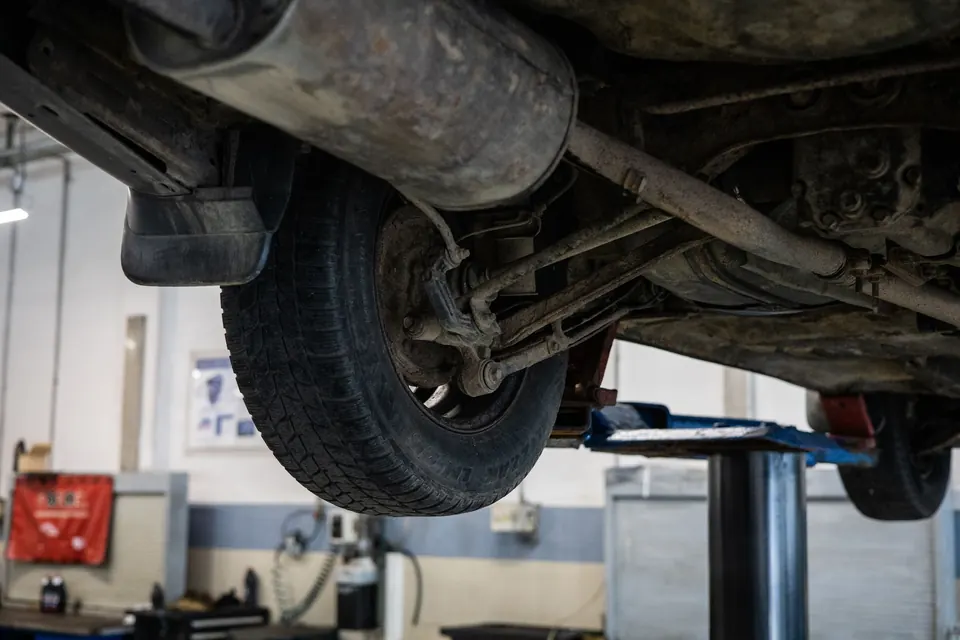
A differential lets the wheels on one axle turn at different speeds through a corner. Every car has at least one. An AWD or 4WD vehicle has two, one front and one rear, plus a device that splits power between the axles: a transfer case on most trucks and body-on-frame SUVs, or a power transfer unit on many car-based AWD vehicles. Each of those housings is a gearbox with its own oil, and the oil is all that stands between hard-working gears and metal-on-metal wear.
| Component | Typical fluid |
|---|---|
| Rear differential | Hypoid gear oil, often 75W-90 or 75W-85; limited-slip units may need an additive |
| Front differential | Gear oil, or shared with the transmission on some transaxle designs |
| Transfer case | Often ATF or a maker-specific transfer case fluid |
| Power transfer unit | Gear oil or maker-specific fluid |
Your manual names the exact fluid for each. These are common patterns only.
When is the fluid due?
The owner's manual decides. Many manufacturers list differential and transfer case fluid replacement in the 30,000 to 50,000 mile range under severe service, and some list longer intervals or inspection only under normal use. The Car Care Council recommends checking these fluids at regular intervals, and our What is due tool uses that general guidance alongside your manual.
Severe service for these components usually means towing, plowing, off-pavement driving, and driving through water deep enough to reach the axle housings. Water is a real issue. Axle breathers can pull in water when a hot differential is dunked in a cold stream or snowmelt puddle, and water-contaminated gear oil looks milky.
Why does Northern Nevada driving wear these fluids?
A typical week here can include dusty dirt roads out to the Pine Nut Mountains or Peavine, a towed trailer on US 395, and a snowy climb up Kingsbury Grade. Heat matters too: a rear differential pulling a camper through Washoe Valley in August runs hot. Rural Lyon and Douglas County households own more vehicles on average than Reno households, 2.29 and 2.25 per household versus 1.76 (Census ACS 2020-2024), and many of those are working trucks.
What are the warning signs?
A whine that changes with speed, a clunk when shifting into gear, binding or chatter in tight turns on a vehicle with a limited-slip unit, or wet residue on the differential housing. Our grinding or whine from the rear end page describes what usually causes those. Noises can mean worn bearings or gears, which is repair-shop work.
What we do about it in the bay
Our differential service covers front and rear differentials, and we look at the transfer case and PTU while the vehicle is up. The technician confirms the fluid each component calls for, including any limited-slip additive, checks for leaks and water contamination, and tells you what was found against the manufacturer's interval. You decide what gets done. We do not rebuild differentials.
Every one of our four service centers handles AWD and 4WD vehicles. Truck owners may also want the pickup truck differential service page.
Sources
- carcare.org/car-care-guide/ (Car Care Council Car Care Guide, inspection and replacement intervals, read 10/15/26)
- ncei.noaa.gov/products/land-based-station/us-climate-normals (NOAA NCEI 1991-2020 climate normals, Reno-Tahoe airport, Carson City and Minden stations, read 10/15/26)
- data.census.gov/ (U.S. Census Bureau, ACS 5-year 2020-2024, vehicles available per household by county and place, read 10/15/26)