
The oil light came on. What now?
A red oil can light means the engine has lost oil pressure, and an engine without pressure can damage itself in a short distance. Pull over safely, shut the engine off, let it sit, then check the dipstick before you decide anything else.
4.7 stars from 952 Google reviews
- No appointment needed
- Service while you wait
- Since 1983
- 4 Northern Nevada service centers
- 4.7 stars, 952 Google reviews
Pull over now
General guidance for this symptom. A warning light that is flashing or an overheating engine: stop driving and call.
Likely causes
- Low oil level
The pump cannot pick up oil that is not there. Engines that burn a little oil between changes, a slow leak, or a long gap since the last service all end here. Reno drivers who run 5,000 to 7,500 miles between changes on synthetic (the range AAA gives for many modern engines) can still use a quart or more along the way.
Full-service oil change - A failing oil pressure sensor or switch
The sender that tells the dash about pressure can fail on its own. The engine is fine, the light is wrong. We cannot tell you that from the bay, and neither can you, so treat the light as real until a service center measures pressure with a gauge.
Multi-point maintenance check - Oil that is old, thin or the wrong grade
Oil that has gone far past its interval thins out, and hot days on I-80 or a trailer on the Spooner grade thin it more. Pressure at idle drops and the light flickers at stop lights first. The owner's manual grade, 0W-20 or 5W-30 for most cars on the road here, is what the engine was designed around.
High-mileage oil change - A worn oil pump or worn bearings
This is the one nobody wants. Inside wear lets pressure bleed off, and the light at idle is often the first sign. We do not open engines. What we can do is confirm the level, confirm the grade and give you a straight account of what we saw so a repair shop or the dealer starts with good information.
Multi-point maintenance check
There are two oil lights and they are not the same. The red oil can is the oil pressure warning, and it is the most serious light on the dash short of a temperature gauge in the red. An amber wrench or a message that says oil change due or maintenance required is a reminder, not a warning. This page is about the red one. If you are on the Mount Rose Highway or climbing out of Washoe Valley on I-580 when it comes on, get to the shoulder, shut it down and read on.
At a glance
- Red oil can light = low oil pressure, stop driving
- Amber wrench or oil change due = a reminder, drive in this week
- Check the dipstick once the engine has sat a few moments
- Low on the stick: add oil before you move the car
- Full on the stick with the light still on: tow it, do not drive it

First, which light is it?
Look at the color and the shape. A red oil can, sometimes with a drip under the spout, is oil pressure. It should light for a second when you turn the key and go out as soon as the engine starts. If it stays on, or comes on while you drive, pressure is low right now.
An amber wrench, a spanner, or the words MAINT REQD, Oil Life 5 percent or Service Due is the maintenance reminder. It is counting miles and days since the last reset. It is not reading anything inside the engine. Finish your errand and drive in this week. We reset it as part of every full-service oil change, and our reset guide shows the button sequence if the last service center forgot.
What to do in the next few minutes
- Get off the road. Hazards on, shoulder, parking lot, whatever is closest and safe.
- Shut the engine off. Do not idle it to think about it. Low pressure does its damage at any speed.
- Wait a few moments so the oil drains back to the pan, then pull the dipstick, wipe it, reinsert it and read it.
- Below the low mark or dry: add oil. Any oil of the grade on your oil cap gets you to a service center. A quart from a gas station is fine for today.
- At the full mark with the light still on: do not restart it to drive home. Call for a tow. The problem is pressure, not level, and the engine needs a gauge test.
If adding oil put the light out and the level now reads full, you can drive, slowly and nearby, to the closest service center. Watch for the light. If it flickers again, stop again.
What we do when you pull in
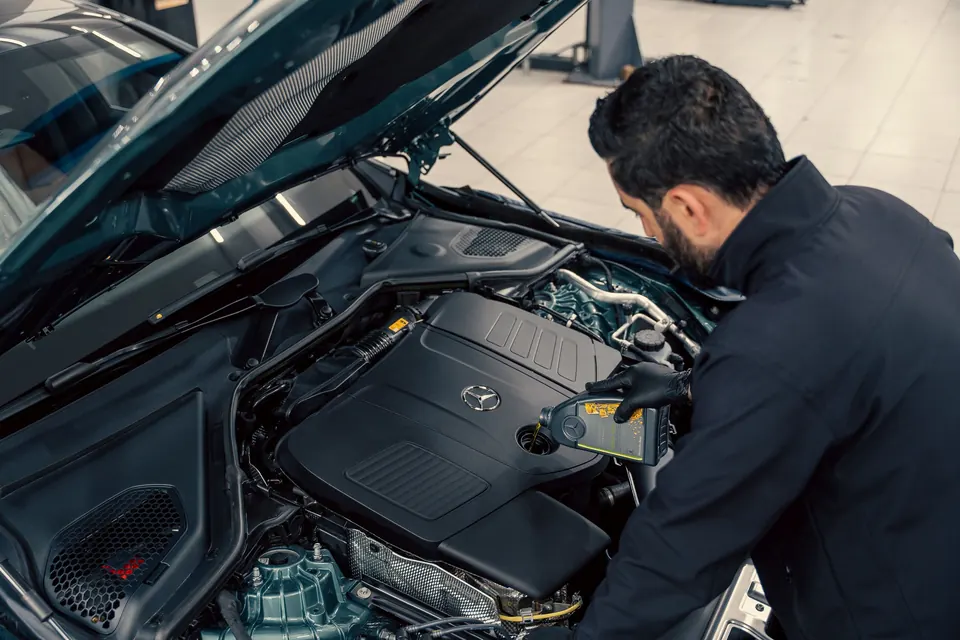
This is a quick lube, so the honest list is short and useful. We check the level and the condition of the oil on the stick, look at the drain plug, the filter seal and the pan for the leak that may have emptied it, and look under the car for fresh oil. If the oil is low, old or the wrong weight, an oil and filter change with the grade from your manual is the fix, and we show you the old oil before we drain it.
If the level is right and the oil is fresh, the problem is pressure inside the engine or a sensor that is lying. We do not rebuild engines or replace sensors on the block. We tell you exactly what we found, written on your invoice, and point you to a repair shop or your dealer for a gauge test. You decide where it goes next. Nobody here will guess at a diagnosis to sell you a service you do not need.
Why Northern Nevada engines run low
Reno sits near 4,500 feet and sees about 65 days a year at 90 F or hotter (NOAA 1991-2020 normals, Reno-Tahoe airport). Hot, thin air and long grades push oil temperature up, and hot oil past its interval burns off faster past the rings. Add a commute that is mostly short trips, which never fully warms the oil, and the level drops a little between every change. Checking the stick once a month is a good habit here. Our between-oil-changes checklist walks you through it.
Sources
- aaa.com/autorepair/articles/how-often-should-you-change-your-oil (AAA: many modern engines on synthetic run 5,000 to 7,500 miles between changes; the manual sets the number; read 10/15/26)
- carcare.org/car-care-guide/ (Car Care Council: check oil level monthly and at every fuel stop on long trips; read 10/15/26)
- ncei.noaa.gov/products/land-based-station/us-climate-normals (NOAA 1991-2020 climate normals, Reno-Tahoe International Airport: 65.1 days a year at or above 90 F; read 10/15/26)
Your service center: Reno Northwest
- Call(775) 787-1000Mon-Fri 8 am-5 pm, Sat 8 am-4 pm, Sun closed
- Address6100 Mae Anne Ave, Reno, NV 89523
Related
Drive in. No appointment. Drive out.
Locally owned in Northern Nevada since 1983. No appointment, no pressure: we tell you what the inspection found and you decide.
About usServices
What we do about it
Straight answers
Questions people ask
Still have a question? Call your service center or drive in; there is no appointment to make.
Can I drive to the service center with the oil light on?
If the light went out after you added oil and the stick reads full, yes, a short drive at an easy pace. If the light is on with oil at the full mark, no. Tow it. The damage from a few miles can cost more than the tow.
The light only flickers at stop lights. Is that still serious?
Yes. Flicker at idle is the usual first sign of low level or worn parts. Check the stick today and drive in. It gets worse, not better.
Will an oil change fix an oil light?
It fixes the light when the cause is low, old or wrong-grade oil, which is common. It does not fix a worn pump or a bad sensor. We tell you which one you have as far as the bay can show, and send the rest to a repair shop.
Does the oil change due message mean the same thing?
No. That message counts miles and time. Drive in this week, not this minute. We reset it with every oil change.

Four service centers, no appointment
Drive in today. No appointment needed.
No appointment needed at any of the four service centers. Questions first? Send the form and the service center you pick answers during business hours.
4.7 stars from 952 Google reviews
- No appointment needed
- Service while you wait
- Since 1983
- 4 Northern Nevada service centers
- 4.7 stars, 952 Google reviews